Already done
You discover months later that a near-identical review or cohort study already exists.
Validly uses specially curated AI model that instantly checks your idea against a strict rubric, FINER criteria, redundancy signals, published studies, protocols in progress, and feasibility constraints, then generates a private report.
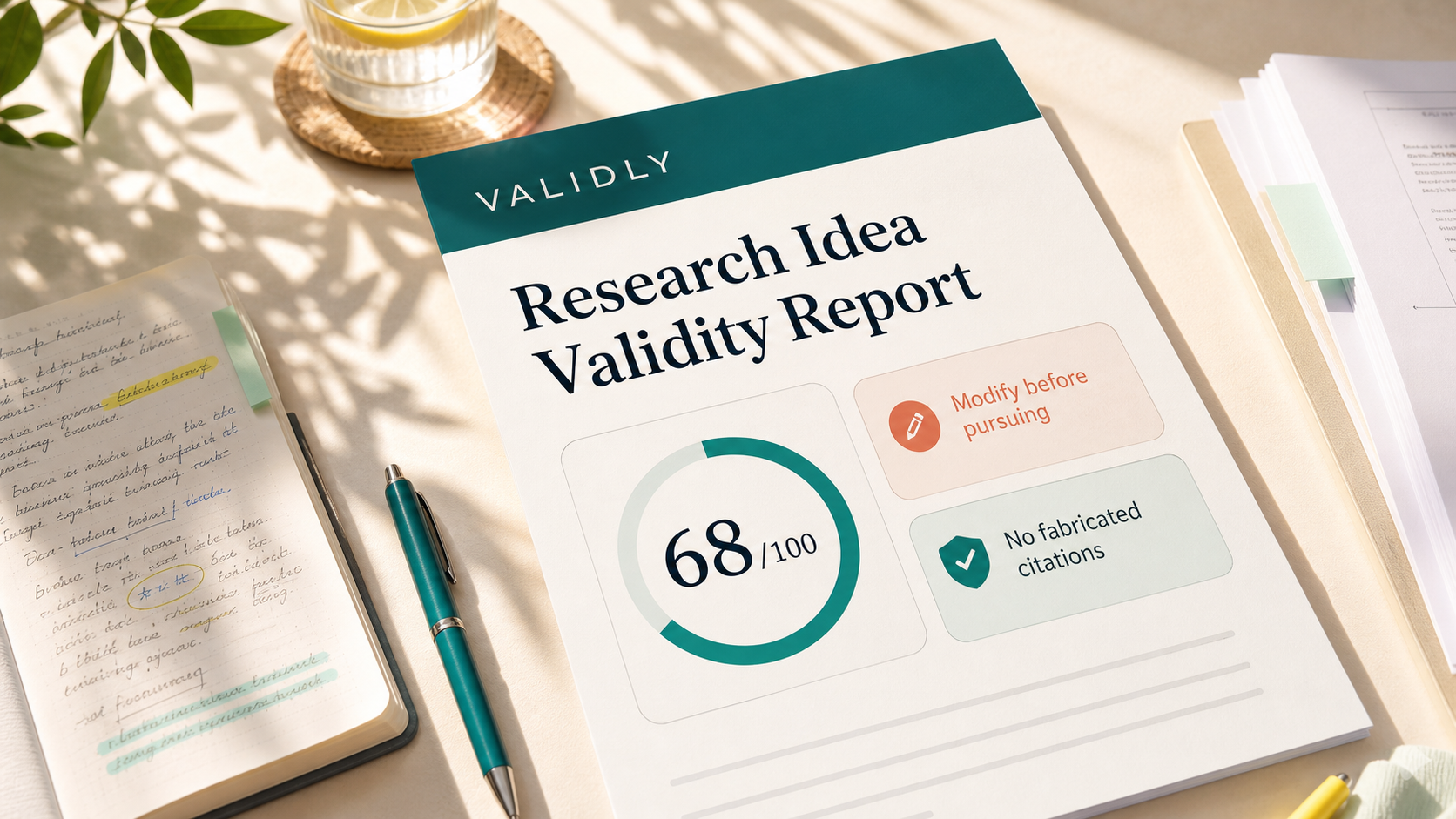
One free scan per month. No public submissions. No fabricated citations. No publication guarantees.
The real failure point
You discover months later that a near-identical review or cohort study already exists.
The question sounds interesting but has no sharp population, comparator, or outcome.
The literature gap exists only because the framing is weak or the search was incomplete.
Validity checks
Not just whether the title exists, but whether the framing is meaningfully different.
Flags direct duplicates, adjacent evidence, and saturated review questions.
Checks timeline, data access, team skills, sample size, and execution risk.
Tests whether the design can actually answer the question being asked.
Separates meaningful decisions from low-impact descriptive projects.
Turns weak ideas into sharper, safer, or faster-publishing alternatives.
First beta offer
The first productized report checks whether a research idea is already saturated, too broad, poorly framed, or still defensible with a sharper question and better methods.
Workflow
Create an account first so your monthly free scan, credits, and referral rewards can be counted.
Your rough idea becomes a structured PICO, PECO, or study-design map that can be scored consistently.
PubMed, Europe PMC, OpenAlex, optional Scholar provider, and PROSPERO-style checks look for published studies, overlap, meta-analyses, trials, and in-progress protocols.
The report appears immediately in your tab. Download the PDF before closing. If encrypted history is enabled, only your signed-in account can reopen saved reports.
Report preview
Every report applies detailed Validly criteria, FINER, red-flag overrides, redundancy analysis, meta-analysis update logic, feasibility, ethics, and publication positioning.
See sample reportSample report library
Best reframed as a preclinical translational synthesis focused on RV remodeling outcomes.
Likely needs a narrower population, biologic class, and outcome window to avoid redundancy.
Broad review is saturated, but subgroup, dataset-bias, or deployment setting angles may remain useful.
Best first use
Many student-led and junior research projects fail because the question is already saturated, too broad, not answerable, or not worth the time. Validly flags those risks early and suggests sharper alternatives.
Beta pricing
Beta payments use PayPal first. Credits are applied after the PayPal receipt is matched to your signed-in Validly account; automation will be added after the beta payment flow is proven.
Trust posture
Validly is a research planning tool. It does not replace a full literature search, institutional review, statistical consultation, supervisor input, or journal editorial judgment.
Submit idea
Sign in first, then use one free monthly scan or credits. Your report is generated immediately; download the PDF before closing. Live deployments can also save an encrypted copy that only your account can reopen.
Account required
Create an account first. Accounts unlock one free scan per month, credit balance, referral credits, and encrypted report history when enabled.
Password reset
Use the reset link sent by email to create a new account password.
Your workspace
Download PDFs immediately. If encrypted history is enabled, saved reports can be reopened from your account; the owner does not receive a readable idea inbox.
Export account metadata and encrypted report history, or delete the account. Deletion removes the account and saved report history, then anonymizes operational logs needed for abuse prevention and accounting.
Tell a friend
Share your code. For every new person who signs up with it, your account gains one credit, up to 10 referral credits. Referral activity syncs to the private account tracker.
Ask a question
Send a support or research-planning question. Email delivery activates when `CONTACT_EMAIL` and a mail provider key are configured.
Report generation
Validly is running literature retrieval, protocol checks, the final rubric, FINER, and red-flag logic. Your report will appear in this tab session when complete.
Report authenticity
Scan the QR code on a report or paste its verification token. This confirms the report was generated by this Validly deployment without exposing the submitted research idea.
Sample PDF report
This fictional sample shows the structure and level of critique a Validly report aims to provide. It does not cite or invent specific papers.
Research Idea Validity Report
Novelty, redundancy, feasibility, methodological critique, and better project angles.
Prepared for early-stage research planning. This sample uses placeholder similar-literature rows and does not invent real citations.
Do not pursue this as a broad clinical SGLT2/pulmonary hypertension review. Reframe it toward preclinical right ventricular remodeling and pulmonary vascular endpoints, and verify whether enough new input studies exist to justify an update.
The idea is potentially viable if framed as a preclinical translational synthesis focused on right ventricular remodeling and pulmonary vascular endpoints. Avoid a broad clinical SGLT2/pulmonary hypertension review unless updated searches confirm a gap.
Testable, but outcome definitions need tightening.
Adjacent literature is crowded; update justification is uncertain.
Meaningful translational question.
Feasible as literature-only review if enough studies exist.
Added value depends on a narrow preclinical angle.
Better as structured/preclinical review than broad meta-analysis.
The idea may guide future translational work, but timing depends on whether at least 3 eligible input studies and enough new data are available.
| FINER domain | Status | Explanation |
|---|---|---|
| Feasible | Moderate | Likely feasible if eligible preclinical studies and extractable RV outcomes exist. |
| Interesting | Strong | RV remodeling in pulmonary hypertension is clinically and mechanistically meaningful. |
| Novel | Moderate | Novelty depends on avoiding broad SGLT2/PH overlap and focusing on a defensible endpoint. |
| Ethical | Strong | Literature-only review is low risk, but claims must not become clinical advice. |
| Relevant | Moderate | Relevant to translational cardiopulmonary research if scoped tightly. |
| Clean title | Effects of SGLT2 inhibitors on right ventricular remodeling in animal models of pulmonary hypertension: a systematic review. |
|---|---|
| Research question | Among experimental models of pulmonary hypertension, do SGLT2 inhibitors improve right ventricular remodeling, pulmonary vascular remodeling, and hemodynamic outcomes compared with controls? |
| Population | Animal models of pulmonary hypertension. |
| Intervention | SGLT2 inhibitors, including empagliflozin and dapagliflozin where relevant. |
| Comparator | Vehicle, placebo, untreated control, or standard experimental control. |
| Primary outcome | Right ventricular remodeling and function. |
| Target article type | Preclinical systematic review or structured translational review. |
Production reports must only cite retrieved real papers with links, PMIDs, DOIs, or database IDs where available.
| Paper | DOI/PMID | Year | Design | Main overlap | Threat |
|---|---|---|---|---|---|
| Recent review on metabolic therapies in pulmonary vascular disease | Shown when retrieved | Recent | Review | Broad disease/intervention overlap | Moderate |
| Experimental SGLT2 inhibition in pulmonary vascular remodeling | Shown when retrieved | Recent | Animal study | Close mechanistic overlap | High |
| Cardiometabolic therapy and right ventricular function | Shown when retrieved | Recent | Review | Adjacent evidence | Low |
The broad disease/intervention space is no longer empty. The defensible contribution is likely the narrower RV remodeling and pulmonary vascular endpoint synthesis.
| Existing published meta-analysis | Needs confirmation by live retrieval. Broad reviews appear plausible. |
|---|---|
| Latest review date | Use retrieved records to identify the most recent directly overlapping review. |
| Update requirement | Estimate new trials/studies and patients/animals after the latest review. |
| Minimum input studies | At least 3 eligible studies should be confirmed before a meta-analysis claim. |
| PROSPERO | Check for registered or in-progress protocols before starting. |
| Flaw | Severity | Fix |
|---|---|---|
| Broad disease framing | High | Predefine accepted PH models and exclude incompatible clinical claims. |
| Mixed evidence base | Moderate | Separate preclinical and clinical conclusions. |
| Unclear outcome | Moderate | Specify RV remodeling metrics before screening. |
Effects of SGLT2 inhibitors on right ventricular remodeling in animal models of pulmonary hypertension: a systematic review.
Mechanistic effects of SGLT2 inhibition on pulmonary vascular remodeling and RV-pulmonary arterial coupling in experimental pulmonary hypertension.
Emerging preclinical evidence for SGLT2 inhibitors in pulmonary hypertension: a structured review.
("SGLT2" OR "sodium-glucose cotransporter 2" OR empagliflozin OR dapagliflozin)
AND ("pulmonary hypertension" OR "pulmonary arterial hypertension")
AND ("right ventricular remodeling" OR "pulmonary vascular remodeling" OR preclinical OR animal)Pursue after modification. Start with a narrow preclinical protocol, verify recent reviews, and ask the supervisor whether animal-only synthesis is acceptable for the target journal level.
FAQ
Internal MVP
This view shows browser-session reports for testing and admin CSV exports. It is not an owner-visible idea inbox.
Enter your admin token once, then download accounts, referrals, or access overrides as CSV files that open directly in Excel.
| ID | Title | Specialty | Type | Status | Package | Created |
|---|
Disclaimer
Validly reports are intended for early-stage research idea evaluation. The literature snapshot is based on selected public databases and automated or manual retrieval methods and may not be exhaustive.
Scores and recommendations are heuristic and should be interpreted as decision support, not definitive judgments. Validly does not guarantee novelty, acceptance, publication, funding, ethical approval, or scientific validity.
Users are responsible for verifying findings through complete literature searches, supervisor consultation, institutional processes, statistical review, ethics/IRB review, and appropriate methodological review. Validly is not medical, legal, ethical, statistical, or journal editorial advice.
Privacy
We do not display user-submitted research ideas publicly. Users should not submit patient-identifiable information, confidential institutional data, or sensitive unpublished data unless they have authority to do so.
Account signups and referral events update private account metadata. Research ideas are not written to the account/referral tracker or shown in an owner inbox.
When encrypted report history is enabled, reports are stored in encrypted form so signed-in users can reopen them. Users can delete saved reports from the dashboard. Production hosting, AI providers, and literature APIs may still process request data transiently.
Signed-in users can export account metadata, credit/referral records, verification records, AI call metadata, and decryptable saved report history from the dashboard. Signed-in users can also delete the account, which deletes account rows and saved report history, then anonymizes operational logs that may be needed for abuse prevention, accounting, or reliability.
Report generation may send the submitted research idea to AI and literature providers configured for the deployment. Users should treat Validly as a planning aid and avoid submitting sensitive personal or patient data.
Terms
By using Validly, you agree to use it only for lawful research-planning purposes and to independently verify all report outputs before acting on them.
Validly may rate-limit, suspend, or block usage that appears abusive, automated, fraudulent, or harmful. Features, pricing, credits, providers, and report formats may change while the product is in beta.
Refunds
Beta payments may be collected through PayPal payment links. Credits are granted after a receipt is matched to the signed-in Validly account. Automated payment confirmation will be added later.
Acceptable use
Validly is for early research planning. It should not be used to process sensitive personal data, generate deceptive academic work, or automate abusive traffic.